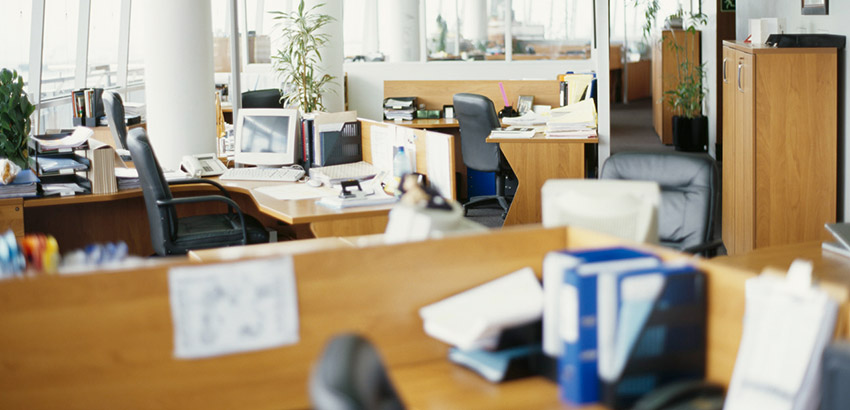
Noise, lack of privacy and difficulty concentrating
Jan Pejtersen, senior researcher at the National Research Center for the Working Environment in Denmark, is an expert in indoor climate and the importance of psychosocial working conditions for the working environment, and he tells in the article "Large-space offices - curse or blessing?", that there are two different approaches to open office landscapes or open-plan offices, as they are also called.
- The positive approach is based on the fact that open-plan offices provide better social relations between employees and thus greater job satisfaction. This is because the increased contact between the employees contributes to better cooperation and more social relationships.
- The negative approach is based on the fact that people who work in large offices lack peace and therefore have fewer social relationships and thus lower job satisfaction. This is because you are afraid of disturbing each other and that you may feel watched.
According to Jan Pejtersens, people in large offices typically complain about noise and lack of privacy. It is especially people's speech and ringing phones that are annoying. Jan Pejtersen concludes on the basis of the investigation "Indoor climate and psychosocial working environment in cubicle, multi-person and open-plan offices", which he himself has helped to create, that there are more negative approaches to open-plan offices than there are positive ones. The study is based on information from 2,300 office workers in 22 office buildings with different office types.
Badly noisy indoor climates were a problem for the employees in large offices, and they had difficulty concentrating. The bigger the office landscapes, the bigger the problems. On the other hand, there were no significant differences in the employees' experience of social support and feedback.
Facts
HISTORY OF THE OFFICES
One of the first buildings with large offices is believed to have been built in the USA as early as 1904. The workplaces were set up like in a classroom with tables in rows and rows, and it was primarily secretaries and office assistants who sat there.
In the 1960s, the open office landscape based on the German "Burolandschaft" gained prominence in the USA. Here, the workplaces were put together in small groups to provide an efficient workflow, and all employees sat in the open landscape.
The Danish development has followed the American one, and in the last 10 years, open office landscapes have really become modern again. The goal is for them to support the modern work process, where knowledge sharing and feedback are keywords.
Source:
'Indoor climate and psychosocial working environment in large offices'.
Talk worse than background noise
Through four studies, the environmental psychologist Helena Jahncke has looked at, how noise affects employees in large offices. Among other things, she let the study participants try out typical office work tasks, with different noise levels in the background.
In a test, for example, the participants had to use several different tables to find a home that was built after 1963, costs more than DKK 500,000 and has an area of less than 63 square meters.
Facts
If your work requires you to concentrate on learning and remembering new information, your efficiency can drop by as much as ten percent if there is a lot of chatter around you.
The very type of tasks where you have to remember variables and use them to look for the right information was one of the hardest things for the participants to do in noisy landscapes.
"We have seen that workers' performance deteriorates by between two and ten percent if you can perceive what colleagues are saying in the background, compared to if there is just a hum," says Helena Jancke in a press release.
She has set up a simple calculation to show the noise costs for Swedish companies:
If you assume that a company has 110 employees who earn an average of DKK 25,500 per month, and you add employer tax on top, the cost of a two percent reduction in efficiency will lead to a loss of one million Swedish kroner annually. Approximately 230,000 Swedes work in office environments, and thus the total loss for Swedish business life can amount to over 2.1 billion Swedish kroner.
Helena Jancke's studies also show that people become more tired and less motivated in noisy environments. This can lead to higher sickness absence, she points out, and those costs are not included in the calculations.
The physical framework must match the work tasks
Eva Bjerrum, research and innovation manager at the Alexandra Institute, analyzes and furnishes large offices as a consultant for various companies. She points out in the article "Large-space offices - curse or blessing?", that large-space offices differ from workplace to workplace, and therefore it is difficult to define unambiguously whether they are positive or negative for the company.
She would rather look at whether the physical framework for the work task to be carried out fits the nature of the task. If it does, open-plan offices can have a really positive effect. More well-being on the basis of social relationships, better collaboration and more knowledge sharing are the biggest gains, she believes. It is therefore important that the company creates the open office landscapes for the right reasons. The fact that the employees sit together must provide benefits, and it must not just be because it is cheap. In addition, the workplace must provide the right framework. There must be more rooms so that employees can move their work process if they need peace or to talk undisturbed. And then the workplace must ensure that the use of the open-plan offices is discussed, so that the employees know the purpose and have some framework to deal with.
This suggests that open office environments can cause problems, but there are also opportunities to solve them if the company reviews the form and defines its use.
Hints:
Think about it before you design your company with open office landscapes - consider what tasks your employees have to solve and look at what framework they are best solved within.
If there are problems with noise in an open office landscape, the company can do various things to remedy the loss of productivity, for example they can make sure that earplugs are ready for employees who need quiet or create rooms where there must be quietly.
Be sure to talk to the employees about how the open offices are used and what is good tone.