
The American occupational psychologist Frederick Herzberg set out in the 1950s and 60s to investigate well-being and employee satisfaction. His purpose was to investigate the importance of one's attitude on one's level of motivation. He therefore asked people to describe work situations where they felt really good and situations where they felt really bad. The result showed that the factors that influence one's job satisfaction are very different depending on whether one describes a good or a bad situation.
Herzberg's work has had a great influence on how managers today work with motivation. In his famous article: "Once More: How Do You Motivate Employees?" from 1969 he put forward his two-factor theory, which in Danish is also called the Hygiene Motivation Theory.
As I said, Herzberg divides motivation factors into two categories, which he calls hygiene factors (often called maintenance factors in Danish) and motivation factors. The hygiene factors can demotivate or cause dissatisfaction if they are not present, but very rarely create satisfaction when they are present. The motivational factors, on the other hand, often create satisfaction and rarely cause dissatisfaction.
The two factors therefore exist on separate scales:

The name hygiene factors is used because, as with hygiene, presence will not make you healthier, but absence can cause health decline. They do not create satisfaction, but are used to avoid dissatisfaction.
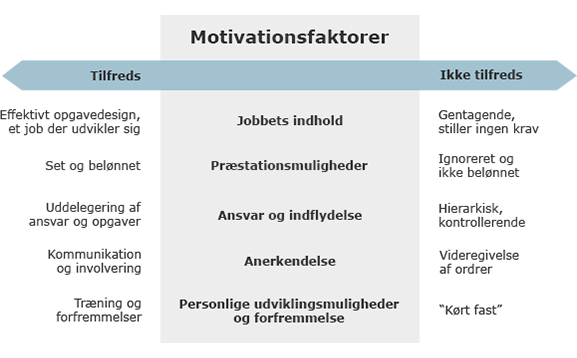
From the two lists above, it is clear that motivation factors and hygiene factors are not mutually exclusive. As it turns out, the opposite of satisfaction is not dissatisfaction, but the absence of satisfaction; not satisfaction. Likewise with dissatisfaction: the opposite is not satisfaction, but not dissatisfaction.
Both lists contain factors that lead to motivation in different ways as they fulfill different needs. The hygiene factors have a specific goal and, once met, do not motivate further, while the motivational factors are much more open-ended. They therefore motivate over a longer period.
According to Herzberg, the hygiene factors are external to your employees' specific tasks. They only serve as short-term motivators; eg. will a constant salary increase simply motivate to wait for the next salary increase and nothing else. (Salary can, however, also be demotivating if the employee considers it to be too low or low in relation to colleagues')
The motivation factors function as internal motivators, are long-term motivating and significant in relation to the job itself and the job's design. Think, for example on the maid, who would rather have a small note with "Thank you for good service" than a thoughtless tip.
Be aware that the two factor types are not mutually exclusive and that management should strive to fulfill both in order for your employees to be truly satisfied with their jobs. Once the hygiene factors are met, adding more factors does not create additional motivation. But, on the other hand, if one does not fulfill them, they can cause demotivation. The situation is different with the motivation factors: even if the management does not meet all of them, your employees may well be motivated.
One of the probably most important ideas that Herzberg put forward on the basis of his studies of satisfaction is the idea of "job enrichment". Job enrichment involves looking at the individual employee's work tasks and adding tasks that engage and involve the employee.
Follow these guidelines:
If a job cannot be designed to utilize the employee's full capabilities, management should consider hiring someone with fewer skills or automating the process. If a person's abilities are not fully utilized, she will experience motivational problems.
To motivate your employees, you need to start a process in two phases. First, eliminate all causes of dissatisfaction, and then help your employees become satisfied.
Herzberg, as I said, called the causes of dissatisfaction hygiene factors. To remove them, you must:
All these actions will help you eradicate the dissatisfaction among your employees. There is no reason to try to motivate your employees until these challenges are cleared out of the way.
But just because your employees aren't unhappy doesn't mean they are! So now you need to start building contentment. And this is where you will start to see motivated employees who deliver more.
To create satisfaction among your employees, Herzberg says that you must work with the motivational factors. You must start the process he called "job enrichment". This is about looking at all the tasks your employees have, and finding areas where it can be done better and more satisfactorily. This can e.g. be:
Despite the wide recognition, Herzberg's theory has some critics. Some say the method doesn't take into account that when things are going well, we tend to look at the things we like about our jobs. When things go badly, on the other hand, we tend to blame external factors.
Another frequently heard criticism is that the theory assumes that there is a strong correlation between job satisfaction and productivity. Herzberg's method does not address this issue, which is why this assumption must be correct for his results to be relevant in practice