But first: What is self-management? There is actually quite a bit of confusion and lack of clarity around Danish companies about what self-management really is. Many see self-management as the fact that employees themselves decide what they want to spend their day on, others believe self-management equals no management.
The definition we use in this article is the following:
” [ … ] by giving freedom and showing trust in the individual employee, [gains] greater access to the employee's self, with a view to using the self in the organization's value creation. On the other hand, this form of management means that the employee, through increased responsibility, gains greater influence on the management processes in the organization, not just regarding their own work in the organization, but also across the organization.”
— (Wikipedia)
Self-directed employees must therefore be able to plan and implement tasks that support the company's goals.
Self-management as a means of motivation
When it comes to motivating employees, there is much to be said in favor of, among other things, self-management motivates far more than traditional financial rewards such as bonuses and raises.
Among other things. Daniel H. Pink makes this argument in his book "Drive". Where, on the basis of a number of empirical studies, he concludes that intrinsic (internal) rewards, such as self-management, "mastery", autonomy and being part of a larger purpose, are by far the most effective. Economic rewards, which he calls extrinsic (external), thus motivate far more memories than has traditionally been thought.
Many have gradually discovered this and self-management is becoming an increasingly common concept in both Danish and international companies.
How do you do?
To be able to lead yourself, there are five things you must know:
- Limit your task.
- Know when you are a success?
- Set goals. Both in the short and long term.
- Prioritize. Know which tasks are most important and do them first.
- Evaluate own efforts. Where did you do well and where did it go less well?
Self-management makes special demands on the manager
But the employee should not sit with these tasks themselves. In order for self-management to function optimally, it is important that the manager clearly outlines the framework within which employees are expected to work. The same applies that it must be clearly communicated which goals and priorities the employee must achieve and follow, in order to support the company's overall goals and strategy.
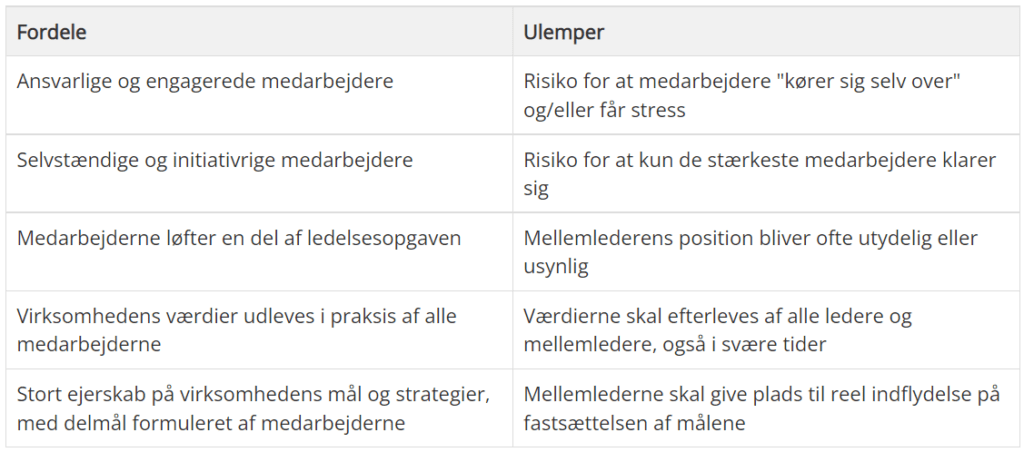
Self-management is not without its challenges
Although self-management has many advantages, it is also important that you, as a manager or self-directed employee, are aware of the disadvantages that self-management often entails. If you're looking yourself, you might nod in recognition to some of these.