How good are you at telling your stories?
In this article, we look at the importance of storytelling for companies, and we meet the travel company Happydays, which has a clear strategy when it comes to using storytelling in their communication both externally and internally.
Storytelling can:
Storytelling has gradually found its place in Danish business terminology, and in short, storytelling involves telling a story about products and services so that they achieve an imaginary value or added value that consumers can identify with. Consumers do not buy the product solely because of its qualities and characteristics, but to a large extent also because of the symbolic value that the product represents. When we buy certain products, we send signals to the outside world about who we are or how we want to be seen. The experience and value also become greater when we choose one of two identical products, which are surrounded by a good story that gives us a feeling of being part of something bigger.
With storytelling, you can add and convey values and attitudes through your products or services, and at the same time create coherence in the marketing, so that it becomes more targeted. Storytelling can also create sympathy and loyalty among the target group, and this increases their ability to remember the company.
Storytelling can create a strong identity for the company, and this is important in the battle for customers and employees. Storytelling can therefore also make the company a desirable place to work, both in relation to recruitment, but also towards existing employees.
At the travel company Happydays, they use their good stories effectively both internally and externally. These are stories about their products told by themselves and by their customers. And these are stories about themselves – told by them themselves about the employees and their daily lives.
FACTS:Happydays A/S
Founded April 1, 2004.
Number of employees: 45.
Homepage: www.happydays.nu
Happydays was named gazelle company by the daily Børsen in 2009 and 2010.
Happydays offers self-drive holidays in Denmark and the rest of Europe, and they differ from other travel agencies in that they tell stories from the employees' working day and use them as part of the brand. Customers are involved in how Happydays works to create the best travel experiences. It takes place primarily online on their website and on Facebook. On the website they have, among other things, a travel club where members comment and give feedback on their travels, and those stories also become part of Happydays' identity. And it pays off. Karin Wenzel, marketing manager at Happydays, says:
- It is a completely conscious part of our strategy that we use storytelling to the extent that we do. From the start, we have had a strong and unconventional strategic vision on the online side in terms of how we communicate. A "corporate identity" of this size is very time-consuming, and it requires zeal and hard work. Passionate and creative minds who don't "go home at 16", but which helps to constantly think differently and focus on the stories. With us, you will not encounter unconscious spar rhetoric. We want people to do more than just sell travel, and we have always had the motto that people should think "what have they come up with this time" when they see our newsletter in their inbox.
If we have to put a little more words on what it is that Happydays does concretely in their storytelling, it can, among other things, is done with an example from their Facebook page. Two days before St. On prayer day, they post a status where they talk about the tradition behind St. Day of prayer and why we eat wheat. In the post is one of the employees' recipes for home-baked wheat with a picture of her and another colleague with their arms full of freshly baked wheat. Other colleagues have commented on the picture and said how good they were. So we are there where it happens, and we are also told that the same employee has previously baked a bread shaped like a camera.

But what do warm wheats and an employee who is good at baking have to do with the sale of travel? The connection is not easy to spot, but it is the story that is in focus. It brings us closer to the employees and the company. This and many other everyday stories from the office are pieces that help form the big picture of Happydays. We see a picture of a company that sells more than travel. They sell experiences and security on the journey. Security because we know the employees well. Customers get more value for money.
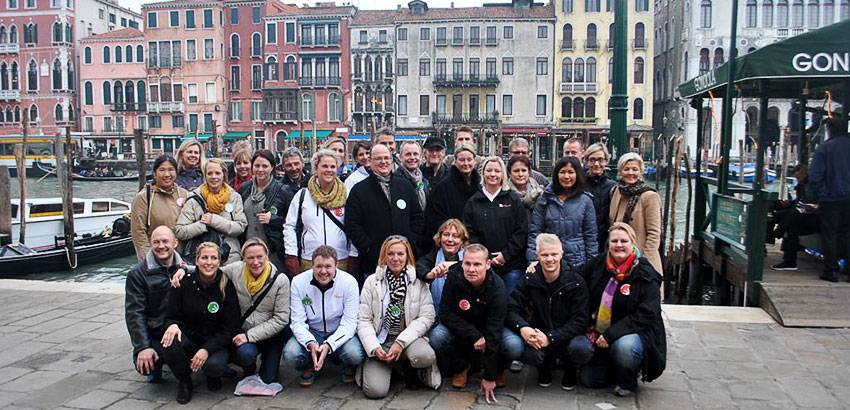
On the website, under the heading "Work with joy" we can follow the employees on a study trip to northern Italy in a small film. Here they visit business partners and test hotels and experiences that they offer customers. Again, added value is added. It gives customers peace of mind to know that Happydays is with them as a travel partner all the way. The film also shows that the employees get along well and enjoy each other's company. Again, a clear added value for the customer to shop in a place with happy employees.
There is a difference in how the two stories are told. According to Karin Wenzel, the story of the wheat comes about by chance, because the employee brings home-baked wheat and the conversation revolves around the tradition behind it. The story is not formalized and "it just happens", says Karin Wenzel. That we have to follow the employees on the study tour is a planned and more formalized story, but still no more than the fact that it is the event that determines the outcome.
- We know in advance that we want to tell the story, and that it was a video combined with still photos is because that is what we had to work with. During the trip, we posted on Facebook about our experiences, and we met 3-4 people in the hotel lobby and said: What do we have? And then we worked from that. It really requires someone to see the fun in doing this, explains Karin Wenzel.

The way they tell stories at Happydays is hard to set rules for, because it's a matter of remembering to tell the story while it's happening. That way you get to tell real stories. According to Karin Wenzel, there is no fixed calendar for when they have to tell stories.
- We have a rule of thumb that we must be visible on Facebook at least 1-2 times a week. Not always with a chrome-plated story. It may just be a good tip or a special hotel we highlight. But we are constantly open to an opportunity, and often say: "That should be on Facebook" or "It's right for the newsletter". So, first of all, it's probably about company culture. You have to have or build a strong culture to be able to use storytelling as we do. And be very self-aware about it, so that no stories are lost, explains Karin Wenzel.
The rules for the content of Happydays' stories are simple:
Storytelling is an ever-dynamic process, and Karin Wenzel points out that she tries to put it in a formula, but that creativity is difficult to tame.
- It is necessary to one degree or another, as the process can easily eat up our time - because it is fun to tell stories. But one thing is certain: the stories don't come by themselves. So we have a focus group, which consists of a bunch of people across departments. The group has a coordinator who ensures that there are regular meetings where you are forced to brainstorm. The result of these meetings are the "big" things like competitions, campaigns etc. While the small stories (the hot wheat) happen "on the fly", says Karin Wenzel.
This is what is stated in the employment contracts at Happydays, and it is an obligation that goes both ways. The vision that they have had from the beginning in 2004, that "it should be fun to go to work" is the background for the online strategy. And it is to a large extent identity-creating for the company to have happy employees, and they want to show us that.
- The storytelling that involves the employees is rarely a sour duty for the creatives, but it can be for those who feel a bit unhooked, and it can also hang out of people's necks that we go and take pictures and play journalists. It can also bother people that we talk about a fun day on Facebook or in the newsletter if they think the boss is a grumpy ass. But it is part of our everyday life that everyone gets involved in the stories. Of course, we find a balance so that everyone can look after their work and just think it's fun to be here, concludes Karin Wenzel with a smile.
Last updated 21 September 2022