The strategy map is typically (and best) developed by senior management and the employees directly below, and, as I said, forms the basis for operational and tactical plans, projects and scorecards. Developing a strategy map requires a lot of work, both by you and your management team, but it is definitely worth the effort.
Before you assemble your management team, there are a few things you need to get your head around. You must collect and create an overview of the following:
Don't jump over where the bar is lowest by imitating what other companies have done. This should be your strategy. And also remember that your vision, mission, values and principles must be connected. If this is not the case, revise them until they do.
When you have done your strategic preparatory work, you are ready to develop your strategy map. The map in the figure below gives you an idea of how the result might be. Your strategy map will probably be considerably more complex than this.
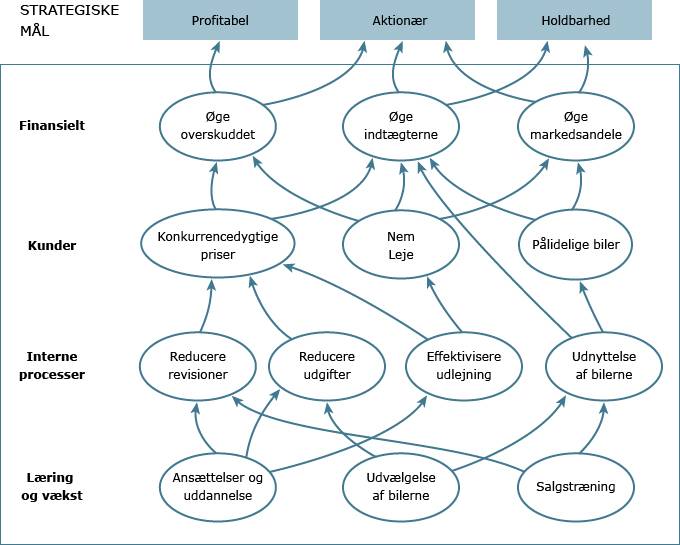
Follow this procedure to create a strategy map:
Some companies start with the financial perspective and set financial goals before working with the other perspectives. Others start with the customer perspective and assess customers, markets, customer trends and future forecasts before dealing with the financial perspective. Which solution is best must be up to the management's assessment of the company and its situation.
However, it can often make sense to start with the customer perspective. Many companies set unrealistic financial targets, which they then push down on the organisation, only to find out that the customer base cannot support them. By starting with customers and the market and then moving to the finances (based on a reasonable assessment of your customers and markets of course), you avoid this problem more easily and avoid having to correct later.
At the same time that the strategy map helps you develop the company's strategy, the finished map also functions as an effective tool for communicating the chosen strategy to the rest of the company. On just one page, you can show the strategy in outline and at the same time describe connections and dependencies. This means that each of your employees can more easily see where he/she fits into the strategy and where he/she can and must contribute to achieving the company's goals.
THE FACTS
Balanced scorecards 4 perspectives
– The financial perspective. How should we present ourselves to our shareholders in order to be financially successful?
– Customer perspective. How should we present ourselves to our customers in order to achieve our vision?
– Internal processes. Which business processes must we be good at in order to satisfy our customers and shareholders?
– Learning and growth. How can we maintain our ability to change and improve in achieving our vision?