Why fail faster?
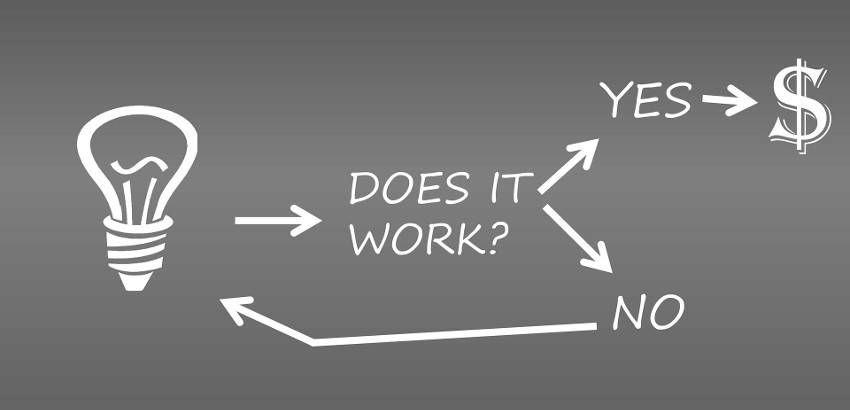
You can prepare your new product by analyzing the market, talking to stakeholders, organizing focus groups, and talking to sales and marketing before developing it. Or you can apply the fail faster philosophy and simply just develop the product and launch it.
If it doesn't match the intention and the need, then you withdraw it and try something else. At least you don't waste more time and effort on the failed idea.
Or imagine that your new sales associate doesn't deliver the item. You have been patient, but nothing happens. Should he get another chance? Should he be coached or further educated? Alternatively, you may realize that the hiring was perhaps not the right one and that you must "fail fast" and move on to a candidate who can meet your company's needs.
Fail faster is a philosophy that applies in many areas of our business. Many - both companies and customers - cannot afford to wait a long time for a new concept that may not even work or catch on. With fail faster, companies can test, adjust and discard products or solutions more quickly.
It is a brave course of action, since you are launching something that may not be worth anything. On the other hand, it is the fastest way to find problems in its solutions, which can thus reach its finished form more quickly.
Here we bring 4 steps to effective fail fast:
1. Think disruptive innovation when you hear fail fast.
The process of both disruptive innovation and fail fast invites you to explore rather than exploit. It is about maintaining a high pace from idea to execution and with plenty of willingness to take risks. It's perfectly okay to make lots of mistakes, as long as you do it quickly. The essence of both disruptive innovation and fail fast is your mindset.
Away with linear thinking through the process. Instead, all phases must be sorted out at once: Idea, development, financing, marketing, sales, etc. You must throw yourself into it without fear, but with lots of curiosity and a desire to learn from your experience.
See possibly our videos with Henrik Sonnenberg and Jonathan Low, where they talk about disruptive innovation as a phenomenon and process.
2. Don't see it as failing, but as learning and discovering!
Fail faster is now a standard piece of advice for entrepreneurs. "It doesn't matter if you stumble along the way. It's good when you find out something isn't working and just move on!”
However, Global Innovation Manager for PwC, Rob Shelton, highlights in this article for Business Insider, that although it is the right idea, it is the wrong attitude in the highest degree!
He refers to a study conducted by PwC on what characterizes innovative companies, and it turns out that one of the most important factors is a formalized innovation process and the ability to quickly test new ideas and scrap the ones that fail. But it's important, Shelton argues, not to confuse that with failing!
Instead, the process is about having a hypothesis, which you then test. If the result does not match the hypothesis, then it is not an error. Instead, you are left with data. If, on the other hand, the result matches, then you have a discovery.
Focusing on data and discovery instead of failure can give the company a stronger mindset, resilient enough to take failed projects as valuable learning and quickly resume the pursuit of the right thing.
3. Be inspired by design thinking
Based on design thinking, the successful Silicon Valley entrepreneurs, Bill Burnett and Dave Evans, have written the book Designing your Life (2016). In it, they highlight how product design is full of mistakes, problems and surprises. The means are often scarce, but on the other hand the goal is paramount. A positive mindset is therefore important for the overall picture.
Problems that cannot be solved must simply be pushed away. It is only the constructive and positive focus that counts. By navigating the goal and quickly developing the best product you can right now, you're able to quickly ship something that can then be tested, remade, and relaunched.
The important thing is the victory in getting a quick result. It creates motivation and provides indispensable experience. There are no errors. No one wins. Only problems and learning.
Burnett and Evans recommend that in the idea phase you start by identifying your goal / your dream for the product and then note how you imagine the process will look. For each point in the process, mark the expected engagement and energy level.
That way you get a feel for which areas seem straightforward and which areas might drag the idea down. It gives your idea / your dream a more realistic picture, as both qualities and challenges are highlighted.
During the actual process for your project, you create a chart that contains all the errors that your prototype shows, as well as whether it is actually an error, a challenge or a development opportunity. In this way, you get to visualize how your mistakes are often new insights and how problems are opportunities. You can then adjust and relaunch a new version of the product. Fail faster, and then quickly move on!
4. Use Pretotyping when you need to launch an idea
Design thinking encourages you to produce a rapid prototype that can then be modified. Pretotyping, on the other hand, is the stage between an abstract idea and a concrete and functional prototype. Pretotyping is a very effective tool to live out the fail faster concept.
The word er is a fusion of the words "pretending" and "prototype" and thus means that you pretend you have a prototype. This is done with the help of small, cheap experiments, which either confirm or deny the viability of your idea. The experiments mimic the core benefits of your idea for a product, service, etc.
Pretotyping is a tool that lets you increase the speed of innovation and product development while saving resources. You can read more about 6 different pretotyping techniques, as well as how you do it in practice, in our article: What is pretotyping?