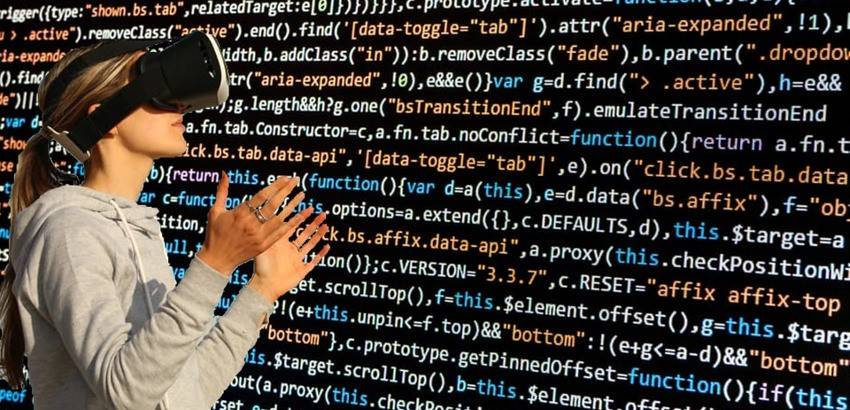
Virtual Reality (VR) has become big business. The entertainment and functional potential of VR and its little brother AR (Augmented Reality) is clear and becoming more and more popular. But the next big thing is probably Mixed Reality, where the best of AR and VR come together to provide a total experience of reality mixed with the digital world.
Perhaps it is best, however, if we just start by taking a step back before diving deeper into Mixed Reality (MR). Is there a difference between VR and AR, and what do the two things even mean? And yes, there is definitely a difference between the two things, although it is a slight technical difference:
Read more about AR's role for our businesses here
Spatial Augmented Reality (SAR)
As if MRI wasn't enough, SAR is also on the way. This technology uses projectors that can change the appearance of physical objects around us. In this way, the material of a sofa or the color of a chair can be changed without wearing glasses or other 'wearables'. In this way, we can move "freely" in a world that changes around us, without us having to control it ourselves. A physical world that changes virtually
But VR and AR are evolving into something new and more advanced: MR. Here, our relationship with technology is changed from being personal to being co-creative. Technological devices go from storing our personal content (as our smartphones do) to being creative spaces mediated to us through technology.
The Mixed Reality experience takes place through a display that is mounted on the user's head. The experience combines the best of the physical and the digital world, where the user receives a real-time image of real surroundings superimposed on a layer of intelligent virtual objects. This symbiosis makes it possible to carry out completely new interactions through movements and vocalizations with a realism that is epoch-making.
The software behind MR is based on two core functions in particular:
If we take a manufacturing company as an example, they will be able to use AR as a pair of glasses that offer a constantly accessible manual for the staff when operating the machines. Crazy smart! However, MR goes one step further. Here, the same glasses (or display) will itself be able to recognize the surroundings and the situation and automatically suggest relevant experts, systems or actions that are necessary to complete a task.
The digitization and technology experts at Accenture Lab predicts that it will be the consumer products, energy and welfare sectors that will initially implement Mixed Reality. They have identified the following three areas in the workplace that are essential to keep an eye on in the near future:
MR will, by all accounts, change our daily life in companies considerably. Both large and small tasks will become easier, faster and smarter. But what does the time horizon say, when can we expect to have to adjust our business to Mixed Reality in everyday life?
Alex Kipman, who over the past 16 years has been the primary developer of more than 100 of Microsoft's patents, says in an interview with FastCompany, that Microsoft sees MR as the key to the future.
Kipman emphasizes that VR and AR technology has long been in a price bracket, which has made it difficult to convince private consumers of the technology. Smart glasses have e.g. more of an impressive proof of what we can develop rather than a product that changes our lives.
The same will probably apply with MRI; it can be a long process to integrate the technology into our daily lives, unless the hardware and software are made sufficiently cheap.
Therefore, during 2018, Microsoft will launch new Windows Mixed Reality Headsets, which unite the AR and VR experience within a price range of 300-500 dollars. With them, users can create a 3D space that they can personalize using media, apps, internet browser, etc. Their own digital universe where they can interact directly with their own ideas.
The Next Web magazine predicts that when MRI becomes available in small, affordable units such as Microsoft's Reality Headset, then it will quickly replace our current platforms. This applies to TVs, laptops, tablets, etc., whose content will be available on MR devices. This development will be particularly accelerated by the 5G network, which is just around the corner.
The technology will revolutionize our communication conditions, as MRI makes it possible to sit anywhere in the world and at the same time experience that you are sitting next to each other in the same room at the same time. Teaching and learning also become far more efficient and advanced, as incredible amounts of information can be presented "live", and the entertainment industry can accelerate almost unhindered in the development of realistic user experiences for e.g. games, movies and sports
Fill out the form to book a 30-60 minute session.
We will respond within 24 hours
Contact us today and hear about your options