Would you like to learn how to penetrate with your message?
We have probably all experienced situations where it was difficult to hit the nail on the head and be precise in the communication. Or conversely, we have been in a situation where we have tried to understand something without being able to "crack the code" completely.
With insight into 4MAT's learning styles, you get a clear picture of your own learning style and of the learning styles of others. You will be better equipped to both target your own communication to others, and to be able to take responsibility for both your own learning and that of others.
4MAT focuses on learning styles and the influence of the brain on people's way of perceiving and translating knowledge. At the same time, 4MAT provides insight into a completely unique teaching and communication model that makes it possible to engage and motivate different types of recipients equally in teaching, learning and communication.
4MAT is therefore aimed at you who would like to get better at preparing, structuring and presenting a message. It can, for example, be:
4MAT enables you to:
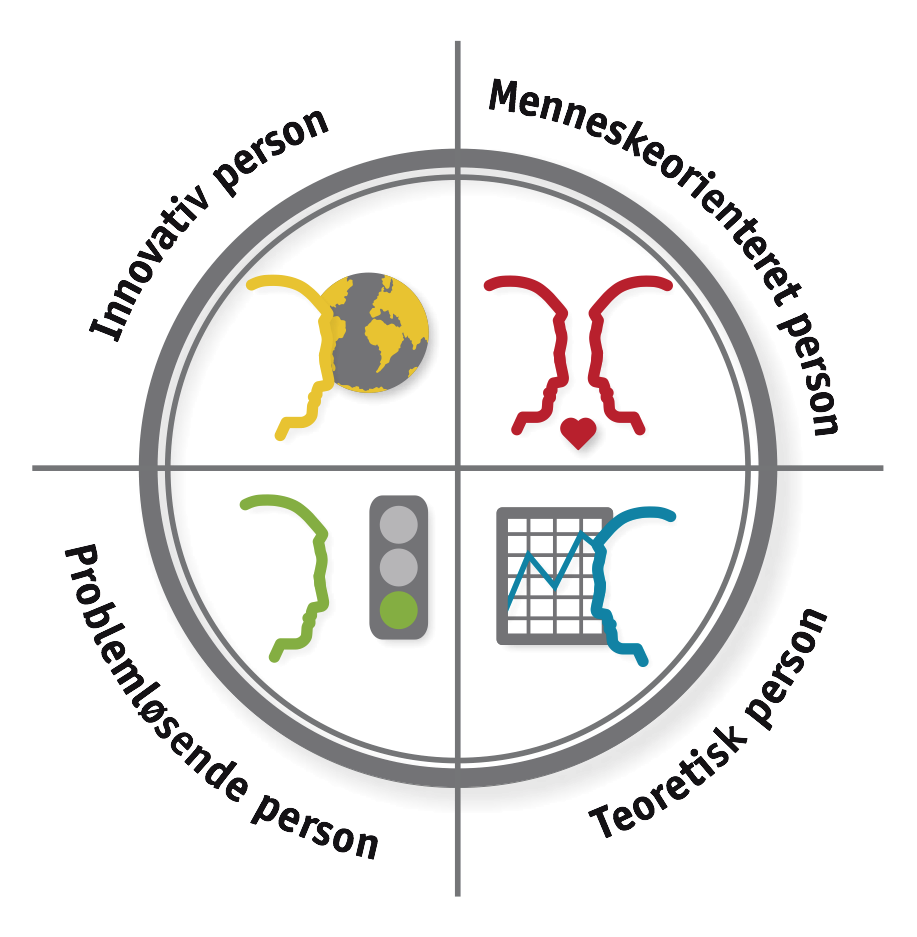
The four learning styles focus on people's differences in relation to communication and learning, and give insight into what is important to you and others in learning. Most of us have one particular area that we like to be in the most. This illustrates the four types based on Jung's typology.
Type 1: People-oriented person – wants to know WHY?
This imaginative type likes to be in a room where "it's nice to be" and where the gut feeling is good. Emotions and reflection are given space, and the thoughtful and approachable person has a good feeling for the people around them. This type seeks personal meaning and commitment, is a standard bearer for common values and wants a good atmosphere where everyone is involved.
Type 2: Theoretical person – wants to know WHAT?
This analytical type likes to be in the space where there is room for logic, reflection and conceptualization. The type is reliable and conservative, seeks facts and gathers data, and wants to know what the experts think. This type likes to get completely concrete and well-thought-out ideas.
Type 3: Problem Solving Person – Wants to know HOW?
This practical type likes to be in the room where there is room to act immediately and test new ideas. The type wants to experiment to find useful solutions, and wants to create concrete utility value from a given idea.
Type 4: Innovative person - wants to focus on WHAT IF?
The dynamic type likes to be in the space where development is closely connected with emotions. It is the creative entrepreneur who seeks new opportunities, likes to explore and challenge ideas – and wants original and creative solutions.
What type are you? Take a 4MAT mini-test here: http://4mat.dk/frontpage-2-(4mat-proces).aspx
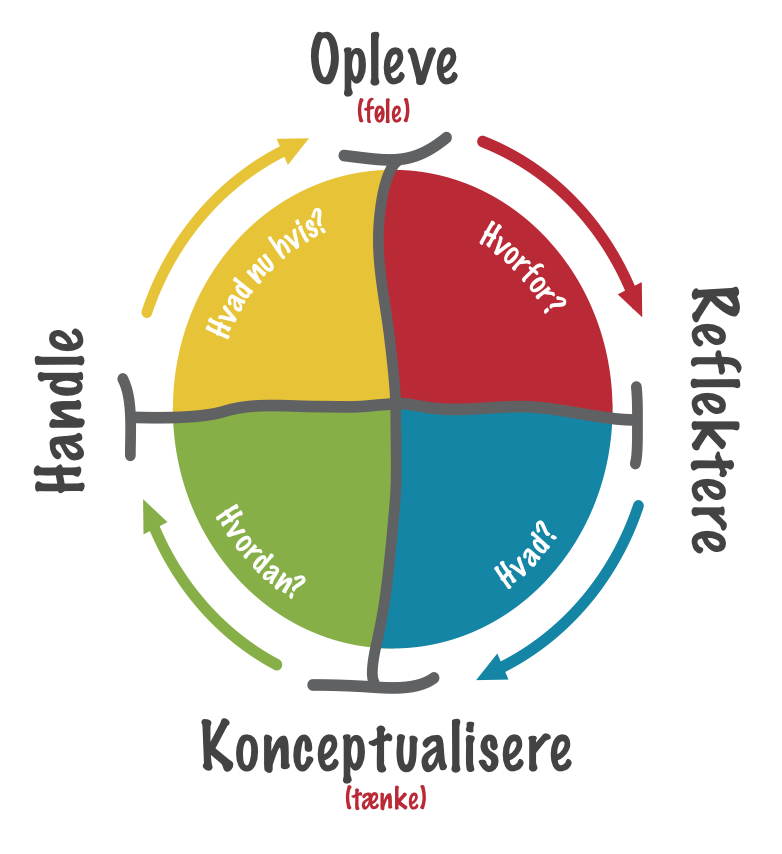
When you know the four types and thus the four learning styles, and have seen how they place themselves in the 4MAT wheel, you can connect what you want to convey further and create a process. You can now build up your material in four phases, the content of which is determined by the four learning styles.
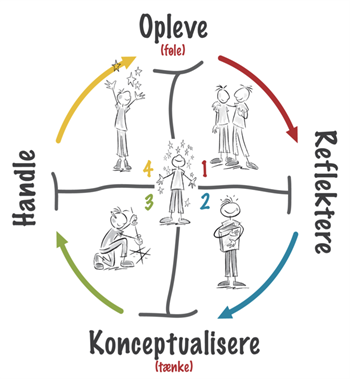
Phase 1 – meaning: Here you find the entrance angle and create the frame. The purpose is that you and your recipients have a common starting point and common expectations for entering the process and learning. Phase 1 is important because the frame creates a sense of security for your recipients and they now know what the topic is and you have built a trust with them. You answer to; WHY your participants have turned up, or; WHY your readers should read on.
Phase 2 – concepts: Here you define the content and tell the participants exactly what they have come to learn. You answer to; WHAT both participants and readers will learn.
Stage 3 – Skills: Here you set aside time to test what the participants have learned in phase 2. These can be exercises for the participants, or practice examples for your readers; "others have done this". You explain them; HOW things must / can be done.
Phase 4 – application: Here you give the participants a perspective and let them see how they themselves can use what they have learned. When they ask NOW WHAT? Do you answer them by making the subject possible to relate to their own everyday life.
The strength of the 4MAT process is that you get all the way through the process. You don't just move through phases 2 and 3, and present theory and facts and then connect exercises. You probably know this well from a teaching situation or from a course. You didn't really find out why this topic was important to you because phase 1 wasn't met. And you also didn't find out how you could relate it to your own everyday life and start using it, which phase 4 gives you the opportunity to do.
You can choose to stop here and enjoy the fact that you now know the four types and thus the four learning styles. You can ensure that your communication goes all the way around and caters to the different types. You can structure your material so that you lead the recipients confidently into the subject and make them want to learn. You can challenge them with knowledge, let them practice and, not least, make them see the perspectives in what they have learned. As I said, you've been all around.
The 4MAT process can be expanded further, and you have the opportunity to refine your communication structure by speaking to both the right and left hemispheres of the brain.
Briefly about the two hemispheres of the brain:
Right brain hemisphere
When we put things in a bigger perspective, we use our right brain. We move in phases 1 and 4. This is where the essence of the subject comes together into a common image. Creativity, intuition and the unstructured lie here. The right half prefers to draw and use shapes, and to answer open-ended questions that do not have a right or wrong answer.
Left brain hemisphere
When we are concrete and learn things by heart, we use the left hemisphere of the brain. This is where rationality and control reside, and it prefers to speak and write. We are moving into phase 2 and 3. Things must be concrete.
When the two hemispheres of the brain are brought into play in the 4MAT wheel, it looks like this.
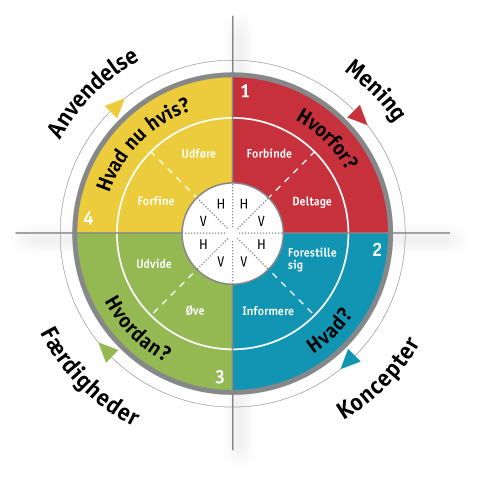
The four fields have now become eight. The left and right hemispheres of the brain are taken into account in each of the four fields. When speaking to the right and left hemispheres of the brain in Phase 1, you need to get the participant or recipient motivated to participate. You do this by connecting the participants to the topic, for example through a good story, which creates a shared experience that the participants can relate to their own lives. It is the broad perspective that speaks to the right part. To make it concrete, you have to get them to participate by letting them discuss or simply make suggestions about how they typically act in relation to the given situation. The participants' knowledge and opinions are brought into play. The concrete speaks to the left part.
How to fill in the rest of the wheel, you can find under tools, and now you're probably dying to start filling out your own wheel, so you can do that here
Do you want to get better at structuring the material you have to convey? When you build your material – it can be teaching material, a plan for a workshop, an article, a sales presentation or an offer – according to the 4MAT model, you experience "coming all the way around".
Here you can download a recipe for how to build your material based on the principles of 4MAT